

BETWEEN PAIN AND PATIENCE:
STORY OF AHMAD FROM SYRIA
In the quiet village of Orm al Joz in Syria’s Idlib, 78-year-old Ahmad Mohammad Zanglo lives in a modest house of concrete blocks and patched walls. The war has reached his doorstep many times, yet he has never left.
Born in 1947, Ahmad spent most of his life working in construction. The long years of physical labor left their mark: his back is curved, his knees give way easily, and he moves slowly, leaning on a crutch that rarely leaves his side.
“I used to work with my hands,” he says, looking down at his fingers. “Now I can barely hold a glass of water.”
Ahmad’s body carries the weight of his years under constant conflict and poverty since 2011. He’s been suffering from kidney malfunction, hypertension, and intestinal problems, making each day a test of endurance for him.
“Everyone here is struggling,” Ahmad says. “The war didn’t only destroy our homes but a destroyed our health, our income, our peace.”
Half of Ahmad’s children fled the village over the past decade. Some crossed the border to Türkiye, others moved north to Salqin and Isqat, searching for safety and work. Four of his children remain in Orm al Joz, trying to rebuild a life amid uncertainty. One of his daughters has a disability and needs constant care.
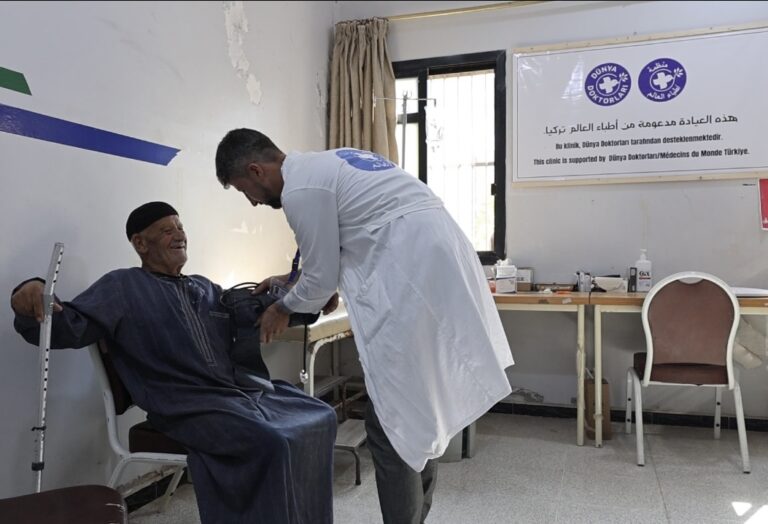
© Ahmad Hallak, Dünya Doktorları/Médecins du Monde Türkiye
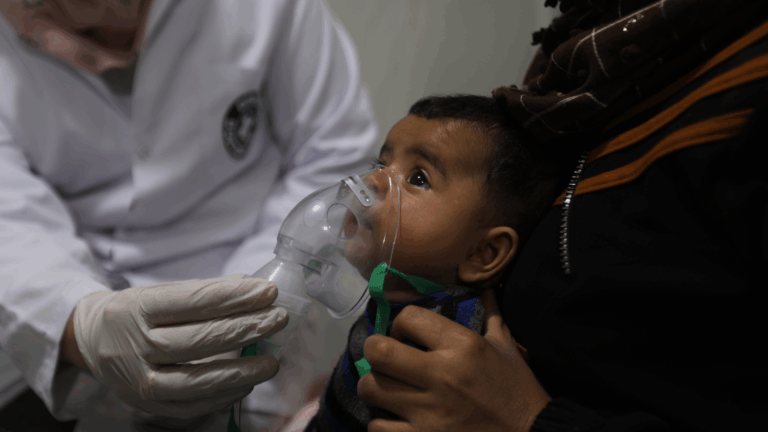
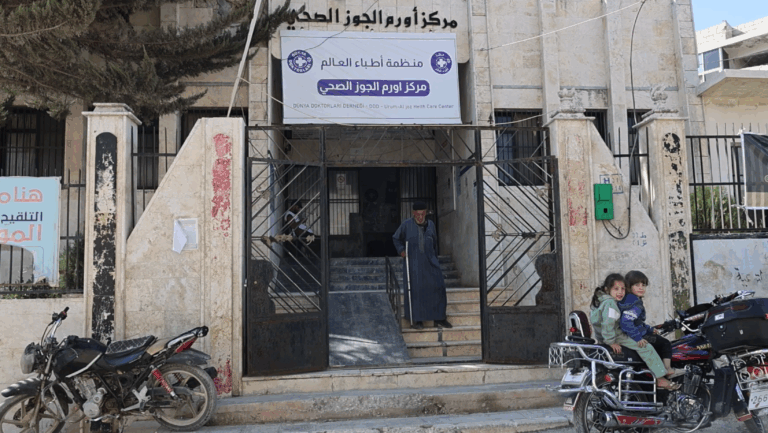
Despite the ongoing hardships, Ahmad says he is grateful for the free medical care and medicines provided by Médecins du Monde (MdM) Türkiye in his village through Orm al Joz Health Center. He can access health services and medication he needs at this center.
Ahmad’s story is one among millions in Syria: lives interrupted but not erased. The war may have bent his back and scattered his family, yet it has not broken his will to live with dignity.
As he sits outside his home now, watching the evening light fall over the hills of Idlib, Ahmad holds onto a quiet strength that has carried him through decades of hardship. “I’ve lost many things,” he says, “but I’m still here.”
In a country where so much has been taken, simply surviving has become its own act of resistance.